Ask ten people for their Italy itinerary and nine will hand you the same list: Rome, Florence, the Cinque Terre, a rushed afternoon in Venice, maybe a Vespa photo in Positano. Then they'll complain the country felt crowded and expensive. Of course it did. They went to the exact same coordinates as everyone else.
The first time I rented a car in Italy, I did it badly. I booked a Fiat 500, drove straight out of Florence toward Siena, and spent two hours stuck behind tour buses on a road that has no business carrying that much traffic. Lesson learned. The real Italy — the best small towns to visit in Italy off the beaten path — doesn't appear at the end of a highway. It appears at the end of a road that gets narrower with every kilometre, where the GPS gives up and you have to ask a man in a vegetable garden for directions.
That's what this is about. Not a ranking of Instagram villages. A working list of towns where you can still eat lunch for under 20 euros, hear a dialect spoken at the next table, and not queue behind forty people holding selfie sticks.
Key Takeaways
- Define your filter first: no high-speed rail, no UNESCO listing, no ferry full of day-trippers. Those three criteria alone eliminate 90% of the "hidden gem" lists you'll find.
- Umbria and Le Marche deliver the highest concentration of genuinely quiet towns within reach of Rome and Florence.
- Shoulder season (late April, late September) is when these places work best — cheaper rooms, open kitchens, empty streets.
- You need a car for most of them. Trains reach the valleys, not the hilltops.
- A small town with 4,000 residents and one good trattoria will beat a famous village with 40 gift shops every single time.
- Book nothing more than your first two nights. The best detours come from recommendations you get over dinner.
What actually makes a town "off the beaten path"?
Most articles use the phrase as decoration. A place gets called hidden because it's smaller than Rome, which is not a useful definition. I use a stricter one.
Three filters I apply before booking anything
A town qualifies if it fails all of the following: a high-speed rail stop within 15 km, a UNESCO World Heritage designation, and a ferry service bringing day-trippers from a cruise port. Miss one of those and you'll still get crowds, just fewer of them. Miss all three and you've found something real.
The second filter is harder to measure but easier to feel. Does the town have a reason to exist beyond tourism? A working market, a small factory, a school that isn't empty in winter. Places with local economies keep their character. Places that live entirely off visitors turn into stage sets by June.
The third filter is time. A town of 3,000 people can absorb 200 visitors a day without changing. It cannot absorb 2,000. So the question isn't whether a place is famous — it's whether its infrastructure is bigger than its reputation.
Here's the thing most guides skip: a village you've never heard of can still be a tourist trap if it sits on a coach route. Always check whether tour buses can physically reach it. If the last two kilometres are a single lane with a hairpin turn, you're safe.
Umbria: the quiet heart that Tuscany used to be
Tuscany has been selling its own postcard for forty years. Umbria, immediately to the east, has the same hills, the same cypress rows, the same stone farmhouses, and roughly half the visitors. The food is arguably better. The wine is definitely cheaper.
Norcia and the mountain towns
Norcia sits in a valley beneath the Sibillini mountains, and it's known across Italy for two things: norcinerie (cured meat shops) and black truffles. The town was hit hard by earthquakes in 2016 and is still rebuilding, which is precisely why it's worth your money right now. You'll eat a plate of strangozzi al tartufo for around 13 euros. In a comparable Tuscan town, the same dish costs 22.
Nearby, Castelluccio di Norcia is a hamlet of a few dozen residents on a plateau that explodes into colour when the lentils flower, usually in late June and early July. Outside those weeks it's a ghostly, silent place with one open bar. That contrast is the point. Go in October and you'll have the whole plateau to yourself.
What to skip in Umbria
Assisi. It's beautiful, it's important, and it receives pilgrims by the busload — three million a year by most counts. If you want the Franciscan atmosphere without the crowd, go to the Eremo delle Carceri, a hermitage 4 km up the mountain above town. Same spirituality, a tenth of the people, and a walk through holm oaks that will stay with you longer than any basilica.
Le Marche: the region Italians keep for themselves
Le Marche runs along the Adriatic between Rimini and Puglia, and it barely registers on foreign itineraries. Ask an Italian where they holiday and Le Marche comes up constantly. Ask a German or an American and you get a blank look. That gap is your advantage.
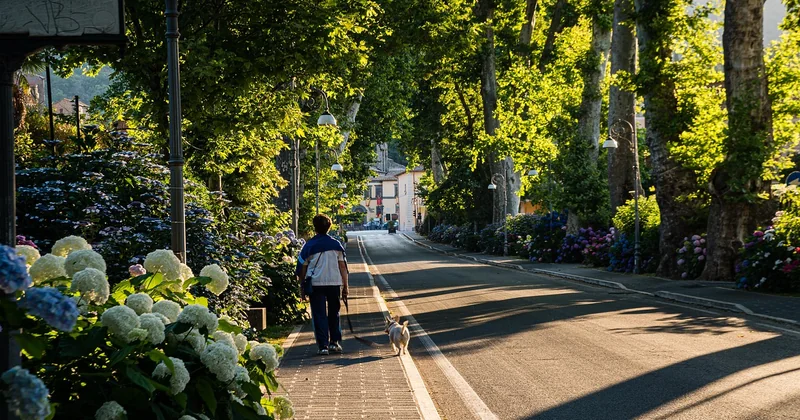
Urbino and the ducal palace
Urbino is a university town of about 15,000 on a pair of steep hills, home to one of the finest Renaissance palaces in Europe — the Palazzo Ducale, built for Federico da Montefeltro in the 15th century. It's a UNESCO site, so it fails my own filter, but the crowds are nothing like Florence's. You can stand in the courtyard of that palace on a Tuesday morning and hear your own footsteps.
What makes Urbino work as a base: it's a real town. Students, bakeries, a market on Saturdays, a football pitch. The torricini, the two slender towers that frame the palace, are best photographed from the road that climbs up from the valley at dusk.
The coast without the crowds
If you want sea, skip the packed beaches near Rimini and head for the Conero peninsula, south of Ancona. The Riviera del Conero is a protected park with white cliffs, and the two small beaches at its foot — Spiaggia dei Sassi Neri and San Michele — are reachable mostly on foot or by boat. In high summer they fill up, but by 6 pm they empty completely. That's when the light hits the limestone and the whole coast turns gold.
One warning, learned the hard way: parking near the Conero trailheads is brutal in August. I once circled for fifty minutes and ended up leaving the car 3 km away in a village square. Go in June or September and it's a non-issue.
Comparing your options: which town fits which trip
Not every quiet town suits every traveller. Here's how the main candidates stack up against practical criteria.
| Town | Region | Car needed? | Best season | Roughly daily budget |
|---|---|---|---|---|
| Norcia | Umbria | Yes | Oct–Nov, Jun | €70–90 |
| Urbino | Le Marche | Helpful, not vital | Apr–May, Sep | €80–110 |
| Castelluccio | Umbria | Yes, essential | Late Jun–early Jul | €60–80 |
| Riviera del Conero | Le Marche | Yes | Jun, Sep | €90–130 |
| Santo Stefano di Sessanio | Abruzzo | Yes | May–Jun, Sep | €75–100 |
Santo Stefano di Sessanio deserves its own paragraph. It's a stone village inside the Gran Sasso national park, half-restored, at 1,250 m altitude. It has one hotel, one restaurant, and a silence you can hear. In winter it's snowbound and nearly empty. In summer it's cool when the rest of Italy is melting.
How to build a route that actually works
The classic mistake is treating these towns as day trips. You drive three hours, arrive at noon, wander for ninety minutes, eat, leave. That's not travel, that's a photo errand.
The two-night rule
Stay a minimum of two nights anywhere you want to remember. The first evening you're a visitor. The second morning you're a regular — the barista knows your order, the woman at the bakery tells you where the good market is, someone mentions a festival in the next village. That second morning is where the real trip happens.
For a 10-day itinerary, I'd allocate it like this:
- Two nights in Norcia, using it as a base for the Sibillini and Castelluccio.
- Two nights in Urbino, with a day trip to the Furlo gorge.
- Three nights on the Conero coast, entirely on foot and by boat.
- Two nights in Santo Stefano di Sessanio to slow down before flying out.
That's four bases, one rental car, and maybe 600 km of driving total. Compare that to the standard Rome–Florence–Venice sprint and tell me which one sounds like a holiday.
Where the money actually goes further
The honest answer on cost: these regions run 25–40% cheaper than the famous equivalents for accommodation, and 30–50% cheaper for food. A double room in a converted stone house in Norcia in October cost me €68 a night. The same standard of room in San Gimignano the following week was €155.
Where you'll still pay full price: car rental in peak summer. Book it months ahead or accept whatever's left on the lot, which is usually a compact with no air conditioning and a suspicious smell. I speak from experience.
Do I really need a car for these towns?
For Norcia, Castelluccio, Santo Stefano di Sessanio and the Conero beaches, yes. Buses exist but run once or twice a day and often not on Sundays. Urbino is reachable by bus from Pesaro, which has a train station on the Adriatic line — that's the one town on this list you can do without a car.
Are these towns suitable for a first trip to Italy?
Partly. If it's your first time, spend the first few days in Rome or Florence — you'll regret skipping them otherwise. Then escape. Most travellers I've met in Umbria and Le Marche were on their second or third visit, and they all said the same thing: they wished they'd done it sooner.
What about the sea — are there hidden coastal towns too?
The Conero peninsula is the strongest option in central Italy. Further south, the Cilento coast in Campania and the Costa dei Trabocchi in Abruzzo offer the same limestone cliffs and clear water as the Amalfi coast with a fraction of the traffic. They're harder to reach, which is exactly why they've stayed quiet.
The thing nobody tells you
Every "hidden gems" article on the internet is quietly working against itself. The moment a town gets written up enough, it stops being hidden. That's not cynicism, it's just how attention works. The Cinque Terre were genuinely remote villages fifty years ago.
So the list above has a shelf life. Norcia and Urbino will get busier. The Conero will get a bigger car park. What won't expire is the method: pick a region, not a town. Drive without a fixed destination for one afternoon. Eat where the menu is handwritten and only in Italian. Stay two nights instead of one.
That approach works whether you're in Le Marche in 2026 or somewhere in Basilicata in a decade. The towns change. The filter doesn't. And the best meal of my last trip wasn't in any guidebook — it was in a village whose name I had to look up afterwards, because I'd only stopped there to ask for directions and the owner of the trattoria wouldn't let me leave without trying the lamb.
That's the whole point. You don't find places like that by searching for them.