You are standing at a trailhead at 6 a.m., and your pack weighs 16 kilos. By noon you will have gained 900 meters of elevation, crossed a north-facing snowfield, and eaten lunch in a 40 km/h wind. Everything in that pack is about to be audited — by your shoulders, your knees, and the weather.
Mountain backpacking punishes bad gear choices faster than any valley hike. Not because the gear is exotic, but because the margin for error shrinks as you climb. I learned this the hard way on a three-day traverse in the Alps where I carried a 2.8 kg tent rated for three-season camping and spent a sleepless night at 2,400 meters listening to it flap like a broken sail. That's the kind of lesson that reshapes a packing list permanently.
What follows is the essential gear for backpacking in the mountains, organized around what actually changes when altitude, exposure, and cold enter the equation. Not a generic list transposed from a weekend car camp. A mountain-specific one.
Key Takeaways
- The "Big 4" — shelter, sleep system, backpack, footwear — still anchor a mountain kit, but their specs must match altitude and season, not just distance.
- Base weight (everything except consumables) should stay under 9 kg for most three-season mountain trips; above that, your knees start keeping score.
- Layering beats insulation: a moisture-wicking base, an active midlayer, and a windproof shell handle more conditions than one bulky jacket.
- Navigation and communication devices are not optional above treeline — cell signal disappears, and weather moves faster than you do.
- Water treatment, a headlamp, and a first-aid kit with blister care are the three items people most often forget and most often need.
- Your gear list should shift between low alpine (1,500 m) and high alpine (3,500 m) — the same trip at different elevations is a different sport.
What are the must-haves for mountain hiking?
The must-haves are the items whose failure ends your trip or endangers you: shelter, sleep insulation, water purification, navigation, light, and weather protection. Everything else is negotiable. In the mountains, that list tightens because help is farther away and conditions shift faster.
I once hiked with a guy who left his rain shell in the car because the forecast said 10% chance of rain. At 2,100 meters, the 10% found us. He spent four hours wet, and by evening he was shivering in his sleeping bag trying to warm back up. A shell weighing 300 grams would have saved the day.
The non-negotiables
- Navigation: paper map and compass, plus a GPS app with offline maps on your phone
- Water treatment: filter or purification tablets, because mountain streams carry livestock and human waste upstream
- Headlamp with spare batteries — darkness arrives fast under canopy or cloud
- First-aid kit, including blister treatment and an emergency blanket
- Emergency shelter: a bivy or space blanket, because a forced bivouac is a real scenario
- Extra food: one full day beyond your plan
What are 10 essential items you need to take with you when backpacking?
Ten items cover the survival layer. These are the ones that appear on every credible mountain list, in some order:
- Backpack — 55–65 liters for multi-day trips, with a frame that transfers weight to your hips
- Sleeping bag — rated 5°C below the coldest temperature you expect
- Sleeping pad — an insulated inflatable or closed-cell foam, because ground steals heat
- Shelter — a freestanding tent, trekking-pole tent, or bivy, depending on exposure
- Footwear — boots or trail runners matched to load and terrain
- Water treatment — filter, UV pen, or tablets
- Stove and fuel — for hot meals and, in a pinch, warmth
- Layers — base, mid, shell
- Navigation tools — map, compass, GPS
- Headlamp and repair kit — duct tape, cord, a multi-tool
Notice what's missing: camp shoes, a pillow, a coffee press, that second book. Those are comfort items, and comfort items are earned by keeping your base weight low.
What is the Big 4 in hiking?
The Big 4 refers to the four heaviest and most consequential pieces of gear: backpack, shelter, sleeping bag, and sleeping pad. In some circles footwear replaces the pad, but the principle holds — these four items dominate both your pack weight and your safety margin. On a typical three-season trip, the Big 4 account for roughly 60–70% of your base weight. Get them right, and everything else falls into place.
My own Big 4 shifted dramatically after that sleepless tent night. I moved from a 2.8 kg freestanding tent to a trekking-pole shelter at 1.1 kg, upgraded my sleeping pad to an insulated inflatable with an R-value above 4, and dropped my base weight from 13.5 kg to 8.9 kg. Same trip length. Vastly different experience.
What equipment do I need for mountain hiking?
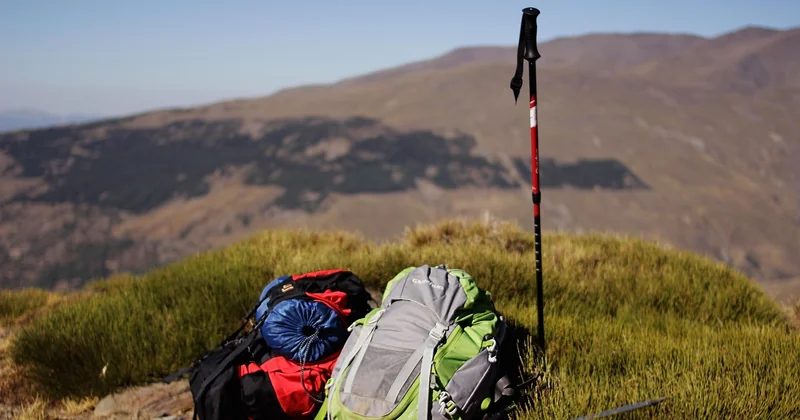
Mountain hiking adds three demands that a valley hike doesn't: insulation against cold that arrives with altitude, protection against wind and precipitation, and the ability to move safely on steep or loose ground. The equipment list reflects those demands.
Altitude and temperature
Temperature drops roughly 6.5°C per 1,000 meters of elevation gain. A pleasant 20°C at the trailhead becomes 7°C at 2,000 meters, before wind chill. That's a summer day turning into a jacket day.
The layering system
Three layers, each with a job:
- Base layer: merino wool or synthetic, never cotton
- Midlayer: fleece or lightweight synthetic jacket for active warmth
- Shell: windproof and waterproof, breathable enough to avoid overheating on the climb
Plus a static insulation layer — a down or synthetic puffy — for stops and camp. This is the piece people underestimate. Your body cools fast when you stop moving at altitude.
| Item | Low alpine (1,500 m) | High alpine (3,500 m) |
|---|---|---|
| Sleeping bag rating | 0°C comfort | −10°C comfort |
| Shelter | Three-season tent | Four-season or reinforced |
| Insulation layer | Light puffy (300 g) | Heavy puffy (600 g+) |
| Water treatment | Filter | Filter plus backup tablets |
| Navigation backup | Phone GPS | Satellite communicator |
| Footwear | Trail runners | Stiff boots, crampon-compatible |
What changes when conditions shift?
Everything. A trip in July at 1,800 meters is a different gear problem from the same route in October at 3,000 meters. Shoulder-season mountain travel demands microspikes, a warmer bag, and often a more weather-resistant shelter. If snow is possible, add traction and possibly an ice axe — and the skills to use them.
What about weight and base weight?
Weight is the silent variable that decides whether a mountain trip feels like a walk or a punishment. Base weight — everything except food, water, and fuel — is the number to track.
For most three-season mountain trips, aim for a base weight under 9 kg. Under 7 kg puts you in ultralight territory, which requires trade-offs in durability and comfort. Above 12 kg, and you will feel every switchback.
The biggest weight savings come from the Big 4, not from shaving grams off your toothbrush. Replacing a 2.5 kg tent with a 1.2 kg one saves more than a dozen small optimizations combined. I spent weeks obsessing over a 20-gram stuff sack before realizing the real win sat in my shelter choice.
Packing strategy
- Heavy items close to your spine, at mid-back height
- Frequently used gear — layers, snacks, map — in side or lid pockets
- Sleeping bag at the bottom, in a waterproof stuff sack or liner
- Rain cover accessible, or line your pack with a trash compactor bag
The mistakes that cost me most
Two failures stick with me. The first was carrying a 1.2 kg camp chair on a five-day trip. By day two I hated it. By day three I left it at a hut, and I've never missed it. The second was trusting a water filter without a backup on a route where the only reliable source was a silty glacial stream. The filter clogged in twenty minutes. Tablets would have saved the day.
Both mistakes shared a root cause: I packed for the trip I imagined instead of the trip I was on. Mountain gear is conditional. The list that works at 1,500 meters in July will fail at 3,000 meters in September.
So build your kit around the specific mountains, season, and route you're actually walking. Weigh everything once. Then weigh it again after the trip — and cut what you never touched. That habit, more than any single piece of gear, is what separates a miserable haul from a trip you'll want to repeat.